

Trees and Artificial Grass
 Question from Courtney:
Hello! We installed artificial grass in a part of our yard about 8 years ago and it has been wonderful space for kids and dogs to play (and then I can garden CA natives/drought tolerant plants/vegetables in the remaining areas!). I would very much like to plant a Gold Medallion tree in this space and was wondering how large of a non-fake-grass ring I need to provide for the tree. Can I bring the “grass” up close to the trunk of the tree (would be very easy to trim it as the tree grows). The yard space is rather small and I would like to retain as much of the “grass” as possible as long as it does not suffocate the roots of the tree. Other plants are very, very happy at the borders of the “grass” and the rain permeates quite quickly through the “grass” and the 2 inches of gravel beneath it. Any help/guidance you could provide would be GREATLY appreciated! Cheers!
Answer from Pat:
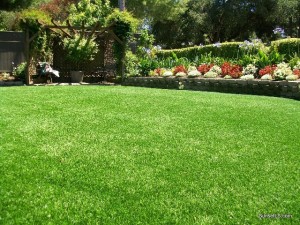
I have seen healthy trees growing extremely well with artificial grass installed right up to their trunks. I have even been impressed by how good looking these landscapes were and have seen flower beds flourishing next to them so that the lawn looked real. It is not necessary to create a circle of organic mulch or real grass to surround the trunk of your tree since the artificial lawn can come right up to the trunk.
There are only two problems to consider—and you should ask your artificial grass company about these subjects prior to planting your tree—one is watering and the other fertilizing. You will need to water your tree right through the artificial lawn or arrange for irrigation beneath it, and you don’t want this action to stain the grass. Also, you need to know how much water to apply to the roots of the tree and make sure it penetrates the ground sufficiently and does not puddle. In the cases I have seen the ground was sometimes mounded close to the trunk so the trunk was not in a dip. Secondly, in order to feed the tree you will need to be able to spread any necessary fertilizer on top of the artificial grass and water it through the grass down into the ground to reach the roots of the tree. So ask the grass company about these two requirements.
In some cases artificial grass surrounding a tree is actually better for the tree than real grass. The warmth provided by artificial grass can speed the growth of tropical and subtropical trees. Also, unlike living grass which grabs much of the nitrogen in the soil before it reaches the tree’s roots, artificial grass takes nothing from the soil. It simply acts as a type of plastic mulch on top of the ground, keeping down weeds, holding in moisture and increasing warmth. (Plastic mulches of various kinds are often used in agriculture and home gardening.) By contrast, trees planted into existing lawns often take a long time to get growing because they must compete with the hungry roots of the lawn.
It may astound some people that a devoted organic gardener would suggest that artificial grass could have any advantages at all, but I am not a purist. I believe that artificial grass is useful in certain situations. You have described one good example and here is another: Side yards are often difficult to landscape since the hot sun can alternate with too much shade. In such a situation artificial grass can provide a ground cover that looks good year-round, takes no upkeep, and saves untold amounts of precious irrigation water. A few vines and colorful potted plants can complete the look. One can even cover the entire area with a shade structure.
I am so grateful that you responded! And that your advice was that which I was hoping for makes it all the sweeter… I will certainly be thoughtful with the watering and fertilizing (have fertilized other plants with no adverse effects for the artificial turf). It was a long process to decide to install this very strange plastic lawn thing but with our 95% hillside yard and two little kids and a boisterous trio of dogs, preserving the 100 square foot flat patch without the inevitable yearly sod/crabgrass failures, we couldn’t be happier. Except with another tree!
Thank you again… You have really been a tremendous help to me in my novice gardening efforts in the past. I shall send you a photo of the tree once I have planted her.
Glad to have been a help!
I am thing about installing the synthetic grass in my yard but my concern is its going to be around a mature Santa Rosa plum tree. I had a sod lawn there but now its dirt and the Santa Rosa plum trees feeder roots are at the surface of the dirt. My two concerns are you need at least 3 inches of prep and if I cut the feeder roots will the plum tree die. Was wondering if any has had the same problem and the results that it didn’t kill the tree.
Thank you for your help
You are correct to worry about your plum tree. Santa Rosa in my opinion is the best tasting of all plums so it is a valuable asset. I don’t think it would hurt to install synthetic grass in place of your front lawn but not under the plum tree. Don’t dig under the plum tree since this would damage the roots and even if this did not kill the tree it would harm the fruiting. Also you need space for mulching and feeding the tree.
If I were you I would leave a circle of mulch under the tree beginning just beyond the drip line of your plum tree. Perhaps you could install a circle of flat landscape bricks surrounding the plum tree just beyond the drip line on the edge of the artificial grass. Then apply mulch on the inside of the circle of landscape bricks. You could even put a low wall there if you wished, like a place to sit.
Regarding putting artificial grass under trees, it does not always harm them. It depends on the species. From what I have observed, olive trees and melaleuca trees survive perfectly well when surrounded by artificial grass. The tougher the tree the better it responds. The main negative of artificial grass is that it is hot when sun strikes it, but in a largely shaded front garden, this is not a problem and it can look good.
I am worried about pruning a macadamia tree with the surrounding artifical grass. Will the falling cut branches damage the lawn or when branches dragged on the lawn?
Nancy
Cover the lawn with tarpaulins to protect it from damage. Take care that neither you nor your tree pruners slip on the tarpaulins which are likely to have a tendency to slide around on top of the lawn.
Thank you for the advice.
Nancy