

Spent Brewery Grains as Compost or Soil Amendment
 Question from Ica:
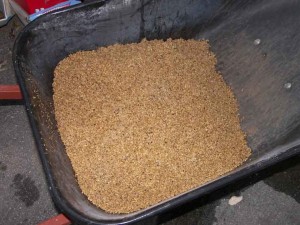
My friend is a brewmaker and has tons of the filtered barley grains they use to make beer. Would this be a good soil admendment? Also should it be composted or can it be added directly to the garden?
Answer from Pat:
Spent brewery grains are an excellent additive to the compost pile, but they vary in characteristics. Some beer companies are learning to use them to make compost and other companies are also recycling them for use as mushroom compost. They can also be used to feed worm bins. Composted brewery grains are one of the ingredients in Milorganite and contribute a lot of its nitrogen.
Most spent brewery grains when used in the compost pile can be classed as a nitrogenous waste (a fast, hot, “green” ingredient, like grass clippings). Layer with some carbonaceous materials such as dry leaves to make a nitrogen-rich compost. Brewery grains can be especially beneficial if you have a bin composter since they are nitrogenous and are easy to compost but need tossing to maintain their warmth. You may have to add some wood shavings to keep the compost from getting too smelly. Brewery grains are likely to be very smelly already when you first pick them up, so get them as quickly as you can after use. Some grains also have allelopathic qualities, that is, like corn gluten meal, they can prevent seeds from germinating. Composting them may not kill this action. Thus I would use this compost in areas of the garden where you don’t intend to plant from seeds and where you would like to prevent weeds from growing. Before using this compost in the vegetable garden, try planting some radish seeds in a container of potting mix mixed with the compost to make sure the seeds germinate easily.
Spent brewery grains are not a good material for mulching due to the fact that they are too smelly and also attract animals. Spent brewery grains that are very soft, wet, and smelly can be dug directly into the soil, as you asked, since they are already well on their way to breaking down and will release nitrogen in the form of gas directly into the ground in a form that plant roots can absorb. On the other hand, spent brewery grains that have been allowed to dry out or cake and get hard should not be added directly to the garden soil. These would subtract nitrogen from the soil in order to rot. Also they will act more like carbonaceous waste in the compost pile. You will need to add water to them so they can puff up again and get going. (When brewery grains are hard and dry some gardeners even recommend layering them with grass clippings to add nitrogen to them, but this does sound odd since the grains themselves are classes as nitrogenous. Under normal circumstances the grains should provide the nitrogenous waste and what you would need to add, if anything, is carbonaceous waste.)
One easy way to compost these left over grains and increase the organic matter in your soil is simply to dig trenches, for example between the rows in your vegetable or cut-flower garden, pour the grain in there, cover it over with soil, and let the worms do the composting.
Pat, I’m a bit unclear on your advice regarding this topic. In the first paragraph your indicate spent brewery grains are highly nitrogenous. In the middle you state once the water is removed, they are a carbon source that siphons nitrogen from the soil. At the end, I understand you to stay they are classified as a nitrogenous product.
Can you clarify this please?
I am sorry if what I wrote is confusing. The main point is that spent brewery grains that are moist work well in compost or even for adding nitrogen to soil, as a slow-acting organic fertilizer. On the other hand if the grains are dry and caked they will act more like a carbonaceous, woody product. Perhaps this can best be explained as the difference between a juicy green leaf, which is nitrogenous, or the same leaf when it is totally dead and dried out, which is carbonaceous. The point is, I were you I would try to avoid getting a load of spent brewery grains that have dried out.
Make it into the ground and mixed ASAP. Sitting around it stinks, majorly. Mix it up by hand or machine, it decomposes quickly if done before it dries out. High altitude and/or hot and dry climate, needs some water added to avoid bricking or globbing. Best way I have found after many 1000s of lbs of material used and maligned by trial and error, get a cement mixer (you can simulate in small form) to mix in existing soils with a 50/50 before you dump it into or onto your ground.
I have not found properly composted (very hot) materials interfere with seeding (mixed in lots and lots at 50/50 directly into the ground) and had a bumper crop of old (5 year old) seeds (GMO, yep even wanted to see if garbage seeds could grow) and they did well with drip irrigation. So your YMMV to the author’s experience or knowledge, I have seen nothing pointing me to inhibitors when done fast as the OP stated, and get it mixed well and down into the ground fast.
I hope my experiences can help others, and thank you all for having a neat forum to use and give feedback upon.d
Thank you for your very good information that should help many people. I am glad to know that according to your experience the gluten contained in the grain does not inhibit germination of seeds when one has mixed the spent brewery grain with earth at 50/50 ratio and buried it in the ground where further decomposition naturally will take place.
How do we know thete is corn glutin in the spent hope? Ask the brewery what sugars they use? I assume HFCS is a big no no!
Thanks!
A variety of grains are used in craft beers, including corn in a few. Yes, ask the brewery. Only natural materials from plants, such as leaves, stems, fruit, or in this case seeds, should be used in compost. Thus, of course not HFCS.
Spent grain compost will help you grow 6 ft tall marigolds, megaflora.
I’m going to touch up the Blackberry patch with this stuff, yum.
What a great reminder. Many thanks for the wonderful comment!