

Raised Bed Planting
Question from Chad:
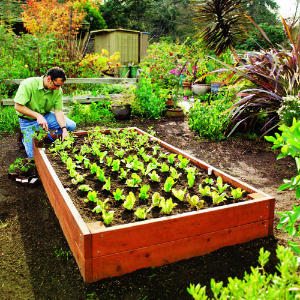
I am just installed a raised 13 1/2 foot by 5 1/2 foot veggie bed in mu back yard that will get great amounts of south facing sun. I have filled the bed with good quality organic soil. I am using a soaker hose that is hooked into the irrigation timer.
I would like tomatoes on the north side and want to plant good companion plants this time of year. I know you dont recommend soaker hose for tomatoes but I want to use soaker hose for the rest of the bed. I am a bit confused as to what to do. I just purchased your book, Southern California Organic Gardening and I realize I have a lot to learn but if you could point me in the right direction as to how to lay out my box I would greatly appreciate it.
Answer from Pat:
What you have done so far sounds fine. Now what I would do is purchase a bag or a box of organic fertilizer recommended for vegetables and work this into the top 6 inches of soil according to package directions. Next you will need to provide a trellis or stakes for tomatoes at the back. Your bed is quite long. It sounds as if you could grow 5 or 6 plants along the back. (The north side.) Maybe in one of the spaces you’d like to grow a cucumber plant. (Burpees Burpless is my favorite, a tall vine that is very productive. Any mild, long, Japanese variety will do well. These are expensive to buy so worthwhile growing. In front you would have room to plant your choice of summer vegetables. See the list on page 199 of vegetables you can plant now. These include such warm-season crops as bush beans, eggplant, radishes, carrots, leaf lettuce, beets, peppers and summer squash. (Choose a compact variety.) Plant a selection of these as soon as next weekend. Loosen up the roots a little before putting each plant in the ground and firm the soil around them. Of course if planting carrots, beets, or radishes, you will have to plant from seeds. Since you are starting a little late I would purchase most crops already growing as plants. Put in some basil too to eat along with the tomatoes. As soon as you plant you should water really well at first so the little plants take hold. Then water with the soaker hose enough so the ground is evenly moist. The plants will tell you if they don’t have enough water since they will wilt.
You are not the only first-time gardener who is at first a little intimidated by the whole process of growing vegetables, but just plunge in and try. Soon you will discover your summer crops are just as anxious to please you as you are to help them grow. Yes, there is a lot to learn but simply by getting going with it, you gradually will learn everything you need to know. In a couple of years you will be an old hand at this and wishing you had more space. But your raised bed is a good size and shape for a great start and since you put it in full sun, in September or October, you will be able to switch to winter crops. Best of luck and don’t hesitate to write again if you want to.
Hi Pat,
We’re new to the area and going to install raised beds soon. Where should we get good quality soil from?
Thank you.
I wish I could advise you regarding where to get good top soil for filling raised beds, but I do not know of a single vendor selling the real thing. If you have a bank on your property you want to get rid of, I would suggest filling your raised beds with native soil from your own property and then amending it with organics twice a year before planting. Another idea is to contact swimming pool builders and see if you could purchase the top foot or two of the soil that has to be removed to make the pool. If it had lawn grass in it that would not matter, since it would rot and improve the soil. Years ago companies sold real soil usually silt excavated from river bottoms. Now unfortunately what they sell for filling raised beds has virtually no top soil in it, only a bit of sand and a lot of ground wood and bark. It drains far too rapidly and requires too much irrigation to keep it moist.
I live in an apartment complex for seniors. Fortunately, residents have a lot of freedom to create whatever type of garden we want. There are two large trees in front of my apartment & the landscaped goes downhill to a fence. The location is perfect for a raised bed as it gets east morning sun & west evening sun & shade in the hot afternoons. Perfect for our hot Oklahoma summers. I want to plant green beans for canning. I like to can them whole as opposed to cut into small pieces. They retain their fresh picked flavor much better in my opinion & I have canned thousands of quarts of green beans over the years; no brag… just fact. Anyway, the soil in this area contains a lot of red clay; typical for Oklahoma. QUESTION: If I build a two foot deep raised bed, how deep do I need to amend the red clay? Or, could I put a layer of rock on the bottom of the bed before I add my soil to make sure I get good drainage?
I live next door to a construction site & the top soil that was being piled up reminds me of corn belt soil; black & smells amazing. So I was able to haul away a few buckets of that “black gold” with the blessing of the contractor. Also, before I plant, I intent to sent a soil sample in to be tested.
Any information or suggestions anyone could share on raised beds will be appreciated. This will be my first experience. I am putting it together with scrape construction lumber, untreated. It is a simple plan. Just connecting the boards together with brackets & drilling holes for string to attach to the fence for easy harvest. I am also planting marigolds in the bed for pest control.
Thanks in advance for any & all suggestions.
God Bless!
Samantha
Your questions are good ones. In your raised beds filled with clay soil, amend with well-composted organic matter to the depth of one foot and do this prior to planting. Also, you can cover the bed with organics in fall and dig this into the ground in spring or dig all the “dead bodies” of plants into the ground in fall and let it it rot over the winter. A covering of manure in autumn would also help, again to be tilled into the ground in spring. This treatment will eventually turn your red clay to good arable ground like what you got from next door. A winter cover crop would also be beneficial but I’m not sure there would be enough time after harvest to plant and grow this so you could dig it in in spring prior to planting. You would need to ask your local University Extension or Agricultural Advisor on this and find out the best most winter-hardy cover crop to choose.
For green beans and other legumes you do not need to add fertilizer but it is a good idea to purchase inoculated seeds or alternatively inoculate them according to package directions with a product for that purpose you can purchase from some seed catalogue companies, such as Harris Seeds. If you wish to plant vegetables other than legumes, which make their own nitrogen, then you will need to add fertilizer according to package directions. In that case, after amending the top one-foot (about the depth of your spade) with organics, then rake the top level and then spread on organic fertilizer appropriate for vegetables according to package directions and then cultivate the fertilizer into the top 6 to 8 inches of soil. You should then irrigate the soil and let the bed settle overnight. The next day you can plant your crops.
Regarding placing a layer of rock or gravel on the bottom of the bed prior to filling with the native soil, the answer is an emphatic no. Whatever you do, don’t do this! Scientific tests show that burying a layer of rock does not increase drainage. In fact it can do the exact opposite and create an underground “swimming pool” for roots, which means they hit that layer and rot. I am so glad you asked this question.
It is nice to have marigolds planted in your bed and may encourage beneficials and discourage pests, but clay soil is not prone to nematodes, which are the main pest marigolds counteract.
My final advice is to plant as soon as temperatures are correct for planting seeds of green beans. Early planting helps to reduce rust and other diseases. Also don’t pick beans early in the morning. Wait until dew has dried. This also helps to avoid rust. Good luck with your project and I’m proud of you for being able to can the produce you raise. Beans also make good pickles.
Another thought: If the weather is cold and wet when you plant, seeds sometimes rot in heavy soil. In that case, pre-sprout the seeds prior to planting. To do this, take a paper towel. Get it wet and wring it out. Spread your seeds in a single layer onto half the towel and cover with the other half. Slip into a ziplock bag, zip it closed and put the whole thing on top of the VCR. Seeds should sprout in three days, but check daily and plant the minute they do. Another tip in clay soil is to cover the seeds with potting soil instead of native soil. This makes it easier for them to push up through. I also put my bean seeds into the ground scar-side down, so the root goes down in the ground and they all come up at once.
Thanks for the blessing with I accept with alacrity.