

Planting California Native Plants
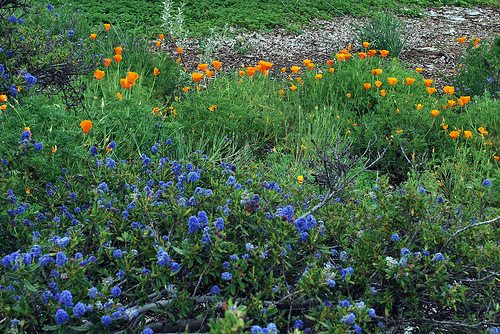
Here is the way to plant native plants (Best time to plant: in November)
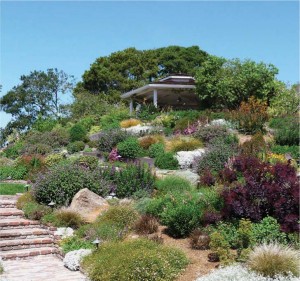 Native plants like best to be planted in plain, native, un-amended soil. Amended soil where garden plants have grown is not the best environment for native plants because native plants are sensitive to fungi and other pathogens that have been brought in with exotic plants. Best scenario is to plant natives straight into bared bulldozed ground with all prior plant material removed.
- Make sure plants were well watered prior to planting. (If they are dry water them in the can again.)
- Clean any existing mulch off the ground, making a large bare space surrounding the hole that has no mulch. (Mulch must not touch roots or get mixed into native soil.)
- Dig the hole to the same depth as the depth of the plant from soil level to bottom of root ball.
- Place the soil you remove from the hole onto clean ground. Or you can put it onto a tarp.
- Fill the hole with water and let it drain out.
- Fill the hole a second time with water and let it drain out once again. (In very dry soil it’s wise to do this 3 times before planting.)
- Carefully remove plant from can supporting root ball with your hands so roots do not break. (Native plants have notoriously fragile roots. Plants are often killed by careless handling at planting time.)
- Sometimes roots are wound around in can. If so, gently loosen them but take care while you are doing this that roots don’t break off from the crown of the plant because of the weight of the root ball.
- Place the plant into the hole with the top of the plant on the same level as surrounding ground. Check the soil level. Fill in with native soil removed from the planting hole and press down with hands, never with feet.
- Use the extra soil taken from the hole to form a watering basin on the edge of the rootball. A week later move water basin out further.
- Replace mulch on top of the ground.
- Water the plant thoroughly.
- Water again the next day.
- Water 3 times a week the first week.
- Water once a week thereafter.
- In summer spritz tops of foliage in early morning or evening to mimic the effect of a brief monsoon rain that washes off dust but doesn’t really get soil wet. These plants can absorb moisture through their leaves. For many natives, watering the ground surrounding their roots in warm weather is likely cause root rot rot and kill the plants.
Photo by briweldon 
What causes Stachy byzantina leaves to yellow and die?
Does it have a period of semi-dormancy? Knowing that it is a low water needs plant, what are it’s specific water, sun, and soil requirements? Should the dead leaves be removed to improve its appearance?
Thank you for your trusted advise.
Tina
I removed my front lawn with has a slight slope. I would like to plant drought tolerant plants which will include some natives. There will be a berm. How should I amend my soil in the whole area? I am thinking of adding pumice to the whole area.
As a general rule amending the soil means adding organic soil amendment (bagged, trucked, or home made compost) and also gypsum if the soil is clay which fails to drain due to alkalinity. I do not advocate adding pumice to soil since pumice is permanent. Pumice is an appropriate additive for potting soils, not for garden soils. By adding it to your soil you would be effectively changing the structure of the soil and this might permanently damage it. Soil structure means the size of the particles in your native soil and the way they interact. Never mess with the structure of your soil, though you can improve it by adding composted organic material. This step is not necessary, however, and may even be harmful when planting natives. I suggest you read the entire section on soil beginning on Page 18 of my organic book.
I removed my front lawn with has a slight slope. I would like to plant drought tolerant plants which will include some natives. There will be a berm. How should I amend my soil in the whole area? I am thinking of adding pumice to the whole area.
At my home in West LA, I planted native trees a few years back (late October) from 5 gal pots, and I planted them a little bit high. My gardener maintained a watering basin around each that was about as wide as the drip line, and he’d cultivate now and then to keep the clay hardpan from forming. He also wasn’t very careful about watering and created holes where the hose water hit the soil. The trees grew but the watering basins didn’t, and the trees have sunk. The basins are now depressions about a foot deep around the trunks (about 2 foot wide radius from each trunk), and I’m worried about water pooling in the depression and causing rot. Is there anything I can do?
Thanks for your help!
The most up-to-date method of planting native plants is to dig a hole slightly larger and shallower than the root ball of the plant, fill the hole twice with water and let the water drain out. Then loosen the roots of the plant, support them with your hands while lowering them into the hole and then refill the hole with native soil that came from the hole with no added compost or soil amendment. Then mulch the top of the ground. If your soil does not drain well it is okay to add soluble gypsum to the bottom of the hole. Plant natives in November, water them during winter but in summer simply spritz the foliage with water on evenings of hot days as if a light rain fell. Do not let water touch the roots.
Regarding the trees you already planted, don’t worry about them. You cannot correct the fact that they sunk. However, you can and should have your gardener increase the size of the watering basin or get rid of it altogether. Tree roots are not there any more. Roots of trees are out under the drip line (the tips of the branches.) This is the place to have watering done, not next to the trunk.